Wednesday, May 11, 2016

Lifer Do-Over and Over 600 Birds

Top End ~ Part Three

I came up with the phrase, “Lifer Do-Over” in the 1 March 2016 Blog. A Lifer Do-Over is getting a second, more conclusive look at a life bird. Wanting this second look means I am questioning the original tick. Something that I do not want to do. While I might be pretty sure, I am not positive. And I do want to be positive!

Several days ago, Lynn and I saw a very pale, streaky headed Cisticola at Fogg Dam. Lynn also had heard the distinctive call from among the reeds in the vicinity of where we saw it. But did she “see” that bird make the call? No, she did not. Therefore, we had doubts. Granted, Cisticolas are one of the hardest identifications in Australia. They are right up there with Swinhoe’s vs Pintail Snipes (yes, we finally did get a photo of the tail feathers. We got Swinhoe’s Snipe in Broome). So, although we had Zitting on our eBird list that day at Fogg Dam, we wanted another look for our life lists.

Over the following days, we tried in multiple places for Zitting without success. We saw a few suspects, but nothing conclusive. We saw some lovely birds though, and here are a few of them.
     
White-bellied Sea-eagle
Crimson Finch
Australasian Darter 
Orange-footed Scrubfowl 
Rufous-banded Honeyeater
Black-necked Stork
Wandering Whistling-ducks
Arafura Fantail
Then on Sunday (Mother’s Day) we went birding with our new friend, Laurie Ross. We went to the flood plains area of Holmes Jungle Nature Reserve. At the bottom of the hill, Lynn and Laurie heard one. We did not locate it and we continued birding the grasses along the road. We saw other Cisticolas, but every really good view looked like Golden-headed and we did not hear any Zitting calling. After about an hour we had worked our way back to the original spot where they had heard the call and yes, they (and even I) heard it! AND this time we saw the Zitting Cisticola perched up on the grass and calling. Seen and heard, finally! It was pretty far, but three of us were on it with eyes (binoculars) and ears. Then it flitted off into the thick jungle of grasses not to be seen again. But we got it! As Laurie said, “One hundred percent tick.” I am really, really grateful.
      
Looking down on the flood plains at Holme's Jungle Nature Reserve. There be Zitting Cisticolas down there!
Lifer high ensued and we took our time hiking back up to the vehicles. We had had to park on the main road since the reserve doesn’t open until 8am and we had arrived at 6:30am. Then in Troopi’s air-conditioned comfort, we headed into town. We were going to the Darwin Botanical Gardens where we had a slim hope that we might find a Rufous Owl. Several days ago, Lynn, Robert, Edith and I had tromped and slogged for several hours through a swampy area in Palmerston that had recently had a Rufous Owl. We saw not hide, nor feather of one.

So we were not really that optimistic when we walked into the Botanical Gardens. Then we checked the “book” of recent bird sightings and YES, a Rufous Owl had been seen there only four days ago! With our hopes higher, we hurried down the Rainforest Boardwalk. As we walked into the shadows, Laurie told us that we were now in the area for seeing them, and about where they had been reported in the book. He was saying they often roost low, just as I was looking up behind us and saying, “It’s higher than you think.” Yes, I was looking at a Rufous Owl. I am so very grateful. What an awesome bird.
    
Rufous Owl! 

Yes, owls are raptors. They have very serious claws.
The bird called a couple of times and when it did, the sun light shone through its throat giving a very bizarre appearance as if a light was switching on inside the owl.
I also want to mention that on 5 May at Fogg Dam Lynn saw her lifer Rose-crowned Fruit-dove and that bird put our “Couple’s Year List” at 600 (and now with the Rufous Owl, 601). Since our beginning date was dictated by our return to Oz last August, our “year” had to start on 20 August 2015 and it will run through midnight 19 August 2016. We will see how we go. Whatever the numbers are, I am so grateful for this opportunity!

Very crap photo BUT it is a recording shot of our 600th Couple's Year List bird. Rose-crowned Fruit-dove!
Peace. Love. Birds.

Tuesday, May 3, 2016

Top End ~ Part Two

We are enjoying the hospitality of my Yabok, Denise Lawungkurr Goodfellow. She is my much respected elder sister since my adoption into the Ngalanbali clan of the Kunwinjku people by my mummah, Una Thompson. This is an honor that I cherish and take very seriously. I am very grateful to be accepted into this wonderful family.

We are staying in Denise and Michael’s guest chalet (as a little cabin, or cottage is called out here) on their large property in the Darwin River area. It is truly bush-cool. It has an “Out of Africa” vibe to it that is awesome. It is hot and humid up here, but after the weeks in Broome, we have acclimated a bit to the heat. I am grateful and I am loving it!
   
Troopi just being a 'vehicle' while we are staying in the chalet.

I am sitting at that table writing this right now. I am grateful.
We have seen some cool birds too. On our way out Sunday morning, Lynn and I got our Lifer Partridge Pigeon. It was early and I got no photos. On our way home that evening after a massive downpour, we saw the world’s wettest, living Partridge Pigeon at the same spot. Then later the next day, Robert spotted one up the road and I got some photos of a beautiful, dry Partridge Pigeon. They are currently my favorite pigeon and I am very grateful!

The world's wettest, living Partridge Pigeon. Honestly, at first I was afraid it had drowned.


A dry Partridge Pigeon... just beautiful.
After our initial sighting of the Pigeon, we headed on to the Shoal Bay Waste Management Facility where there had been a Franklin’s Gull hanging about. After making friends with the nice guy who was the “gatekeeper,” we were basically being told on the phone to “f-off and leave” by his supervisor. Being able to be an asshole and still sound totally bland and disinterested is, I suppose, an asset for a person in a supervisory position.

However, the gatekeeper was cool and let us scope the tip-face from a grassy area by the gate. We had a clear view and the gull was not there. Sneaking in later in the afternoon was also unsuccessful (long story, with a blah ending, so I will skip it). Then believe it or not, I thought I might have dropped my iPhone case there that morning so we had to go back! This time, a guy who worked there recognized me and they just allowed us to go in! We had full access, but sadly the gull was still nowhere to be seen. Not at the ponds in the back, nor on the tip-face. I am very tired of this gull for now. But I am grateful that I found my Swaro iPhone case right where I thought I might have dropped it!

Monday morning we headed out about 50 minutes from here on the Arnhem Highway to the Adelaide River Crossing. It is known as a good birding spot (thank you Tim Dolby). In about twenty minutes, Lynn and I had two Arafura Fantails in the trees above us. Sweet! And a Lifer! We also added Mangrove Golden Whistler to the year list there. It was vocal as, but remained frustratingly un-photographable. That’s very much ok though and I am grateful.

Arafura Fantail looking at us as we were looking at him (or her).

Next we stopped by for a quick visit to Fogg Dam. We first went there in August of 2012. It is a wonderful birding area, but seemed a bit slow and it was quite buggy. We did pick up Rufous-banded Honeyeater for the year list and saw a lovely little Grey (brown) Whistler before the mozzies just about carried us away. For the most part mosquitoes do not bother me, but these were ridiculous. It seems they are quite bad up here in general this time of year, but we can deal with them.

Grey Whistler (brown) they are lovely, understated little birds.
Now we’re mostly caught up. We dipped on everything that we were looking for today. We did have some gorgeous Chestnut-breasted Mannikins, but not a single Yellow-rumped amongst them. Trust me we looked very hard for them.

Beautiful birds... but man, would I love to finally find a Yellow-rumped!
Now I am sitting in our little hut and working on this blog and the photos. I am so lucky to be sitting here and doing this. And I am deeply grateful. I wish you all joy with all my heart and I will keep you posted! Stay tuned there is much more to come...

Peace. Love. Birds.

Saturday, April 30, 2016

Top End ~ Part One

Catching up the blog is more difficult than I want it to be. I will continue, but I am skipping a lot of things that I would love to share. There is just not enough time to do the things and write about them (and edit the dang pictures). Anyway… let’s catch up as best I can.

In our birding of Oz, Lynn and I had had no joy of any Button-quail. Very many people have told us how easy Painted Button-quail are! Just go to this place or that place, but that is usually always after we are 500 kilometers away from those places. We have looked twice up around Deniliquin, NSW for the Little Button-quail without success. We went specifically to Inskip Point for the Black-breasted, but it happened to be the first weekend of school holidays last September and it was utter insanity of screaming kids, bellowing adults and roaring-rumbling 4WDs. We saw neither hide nor hair of any Button-quail. I plan to return this winter and try again!

I would recommend Mike Reed’s wonderful book, “Top End Birdwatching” to any birder coming up here. It is an excellent book. Robert and Edith (a friend of Robert’s and ours as well now) and Lynn and I went by to say, “hi,” to Mike and his wife, Anne. They are awesome people, who I would love to have had more time with. He advised us on a good spot for Chestnut-backed Button-quail. So… sort of bright and definitely early, we headed Troopi and Troopy out of Katherine toward Chinaman Creek. We went to the exact spot that he suggested and we did as he advised. Lynn, Edith, Robert and I walked “grids” to and fro through the grassy area where the Button-quail are known to be. We flushed them four times, getting excellent binocular views as they relocated (i.e. flew and disappeared into the grasses). Tick! I am SO grateful! Finally!

We moved on to Pine Creek and as most birders know, the Hooded Parrots are seen in front of the caravan parks there. They were indeed and they did not disappoint! They are now on our year list.
   
Hooded Parrots       
Sloppy Parrot kisses...


We headed north to a spot that Mike suggested as possible for Yellow-rumped Mannakin (still no joy of those!). Once again, we did not find them. Although we saw a very Zitting looking cisticila, but I reckon it was a Golden-headed.

Cisticola

On the way back to Pine Creek, we decided to make a detour to Douglas River Crossing by Douglas Daly Caravan Park. I had read on Facebook that our friend, Phil Lewis had seen several cool birds around there including Rainbow Pitta. It was way past any sort “bird o’clock” being about noon when we arrived. We parked near the river and began to look around. I headed down along the water and in moments I got to say, “I’ve got the pitta!” The others were in further, but came running. Soon everyone had gotten satisfying looks at one of the most beautiful birds in the world. I am so grateful!
 
Rainbow Pitta!


Yes, we had Lifer Pie in several forms and we had a lovely Lifer Supper the other night with fresh barramundi. More soonish. Sending much love from the Top End.

Peace. Love. Birds.

Friday, April 22, 2016

The Kimberley ~ Part Two

I am beginning this in a camping spot at the very cool Ellenbrae Station just off the Gibb. This place has an awesome vibe to it, rustic coolness. Hard to describe. 
Lynn at a table in Ellenbrae Station. I love that place.
I’ve had yet another shower. Yay! It has been over a month since I showered with hot, or even warm water. It has been just the cold tap since we’ve been up here, and it feels great. I am grateful.
The amenities at Ellenbrae Station... rocky cool!
Saturday the 16th was a slow birding day, but a high learning curve day for driving Troopi over rocks, ruts and holes down “tracks.” She is amazing. We made a semi-bush camp at the closed campground on Mt. Elizabeth Station. 


The following morning we had to decide where we were going. This choice had been coming. We knew where we wanted to go, to the Mitchell Plateau in hopes of the Black Grasswren, but the road up to the plateau had been closed. We had just found out that it was still closed. So, without going into the details, I will just say that after an arduous, rough and rattling drive, we birded on the evening of the 17th. We got Buff-sided Robin and Kimberley Honeyeater and we got them on the Mitchell Plateau. I was very grateful, but we had not seen the grasswren... yet.

Buff-sided Robin

Kimberley Honeyeater
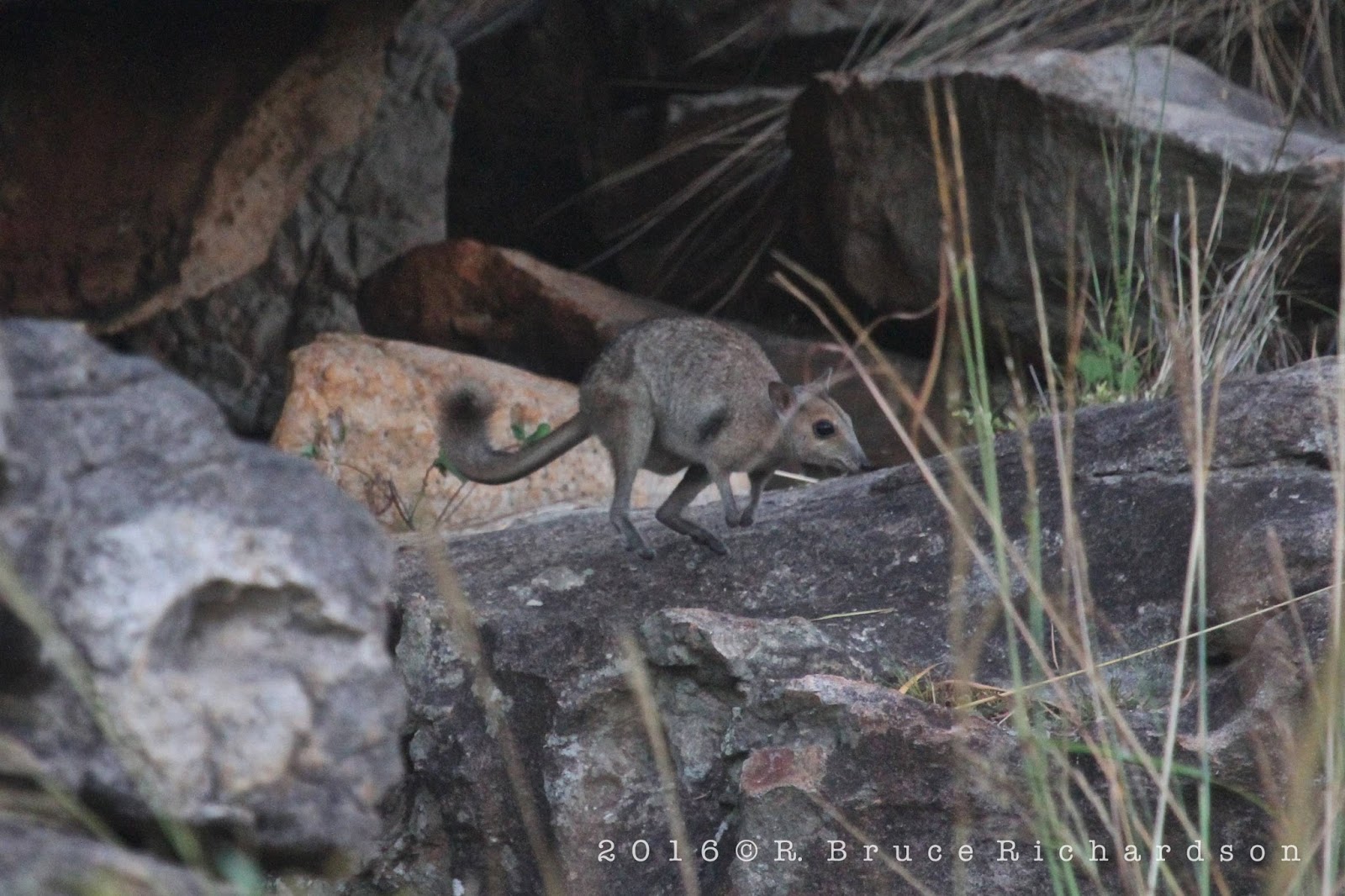
The next morning we were out at first light and across on the rocky escarpment near Little Mertens Falls where these grasswrens are sometimes seen. We had an insanely cute Monjon watching us curiously from the rocks. They are an endemic of far northwest Kimberley and they are the smallest of the Rock-wallabies.


Monjon... a very cool little bundle of cute.
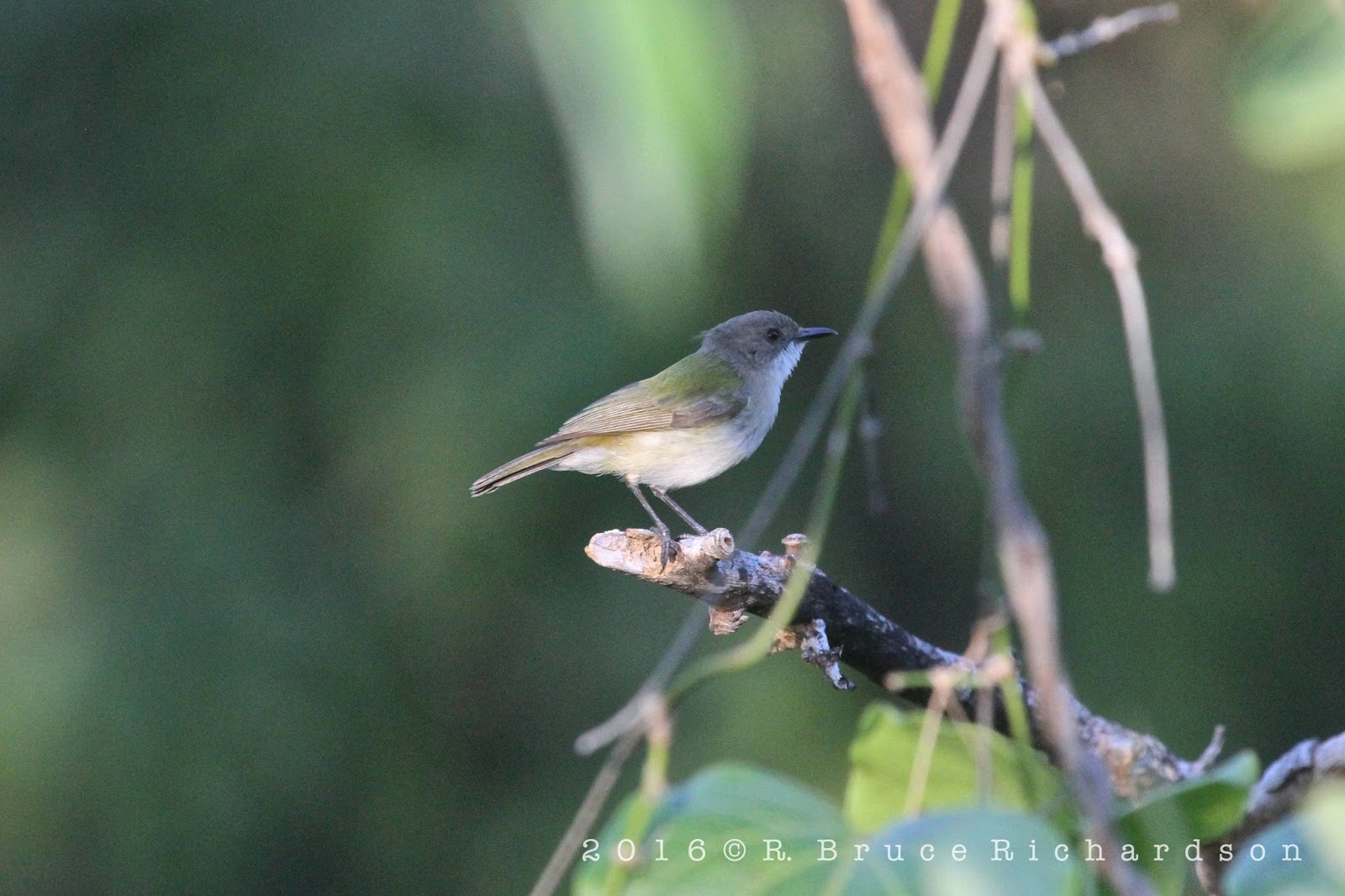
While searching hard for the Black Grasswren, we picked up Green-backed Gerygone, another lifer for Lynn and me.


Green-backed Gerygone
We headed off the trail and really began clambering over, between, across and around boulders. Or as George refers to it, “rock hopping.” This activity favors the long of leg, but Lynn hung in there with us on this very difficult terrain. I am so grateful. A check of her Fitbit showed that we traveled (climbed, clamored, stumbled) about 3 kilometers in total.

Little Mertens Falls (Lynn is in the photo, you just have to look hard).
We emerged from the boulders into a sort of clearing. Lynn took this opportunity to sit down on a rock, and I stepped off to the side behind a boulder (I had drunk my normal two mugs of coffee earlier). And at that moment, George found the grasswrens. Needless to say, I immediately stopped what I was doing and in seconds Lynn and I were standing beside him looking at two females and a male. The Black Grasswren is one of the most beautiful birds I have ever seen. It truly is. I was able to grab a few photos and then we let them be. They had shown themselves beautifully and owed us nothing more. All that we had gone through to be there was so very much worth it. What a bird. What a place. I am grateful.
The little clearing... that boulder in the center back is where they first showed.
Black Grasswren! (male)
Black Grasswren female

The male again, from the right angle they do look black.
We left this wondrous place and drove back down the amazingly rutted, horribly corrugated, mud-hole filled track. After once again safely crossing it, we stopped and had a luxurious swim in the King Edward River.
Troopi making us proud! Crossing the King Edward River (again). Thank you, George for taking our photo!
Lynn coming back from a swim.
Our swimming rock... a lovely place to slip into the river!
We headed to Drysdale Station. They had showers, as I mentioned at the end of Part One. It was a lovely evening, and a very lovely shower! What a day that was! Black Grasswren, I am so very grateful!

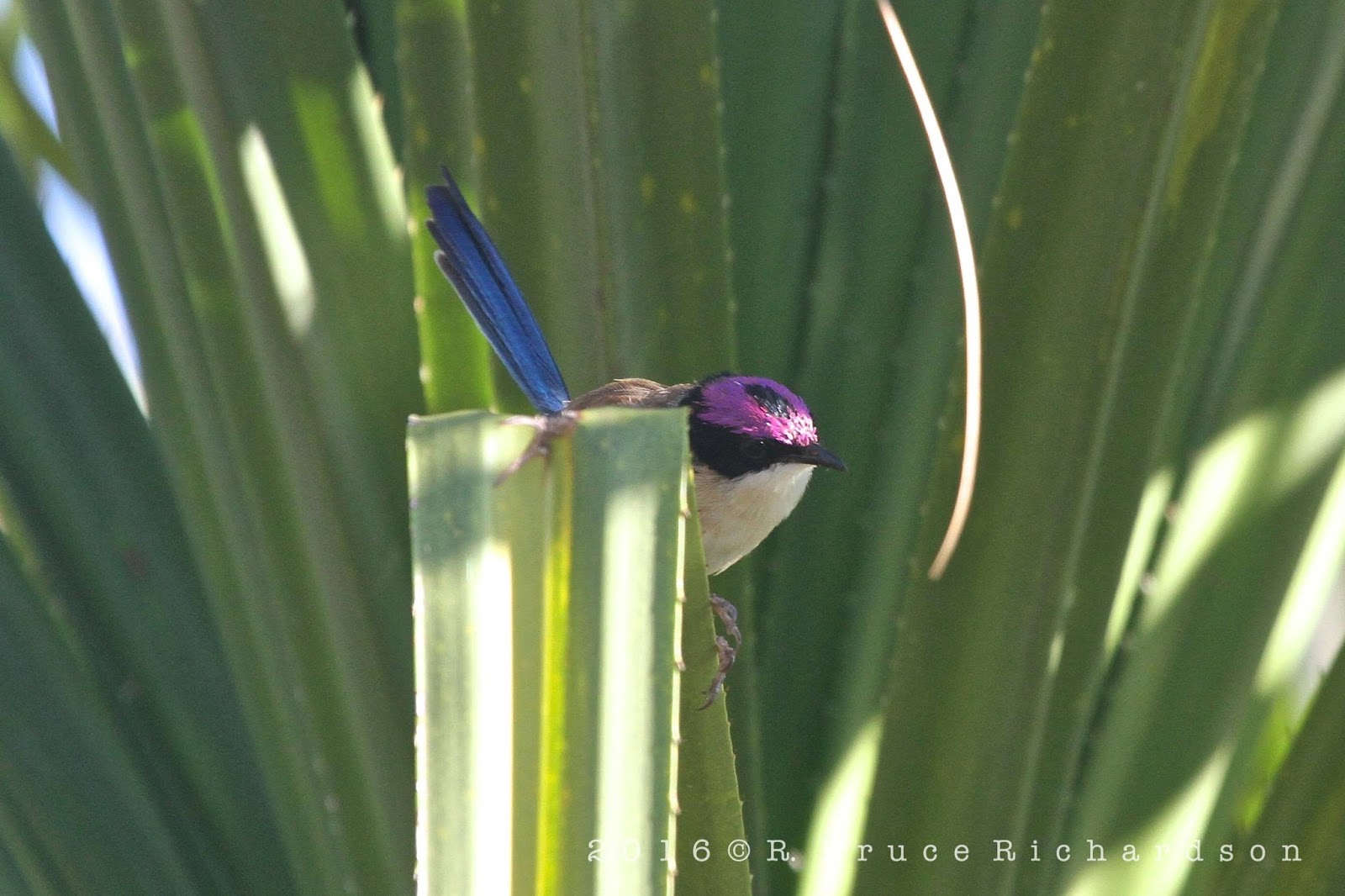
The next morning we went to Miner’s Pool just north of the station and saw Purple-crowned Fairy-wrens again. The males were more in color than the ones we saw a couple of days ago. What gorgeous birds they are! 
Purple-crowned Fairy-wren. We have now seen all of the Fairy-wrens. I love them. 


On our way back to the main road, we stopped at the Gibb River crossing and gave Troopi a wash (no soap, just a good rinse).
Lynn was washing on the other side... our girl had gotten very muddy!
Then we reluctantly parted company and George headed west on the Gibb and we headed east. He taught us what Troopi can do and gave us the confidence to travel on and explore some of the more wild parts of Oz. He also showed us real bush-camping. Yes, we can do it, and we will do it again. Thank you, George, I am grateful.


Peace. Love. Birds.